
You are not closing enough deals.
The price keeps coming up. Prospects hesitate. Conversations stall. And the obvious solution feels like it is right there — just lower the number and the resistance goes away.
Do not.
Here is what is actually happening when someone objects to your price. And why dropping it almost always makes things worse.
Why Lowering Your Price Is Almost Always the Wrong Answer
The Only Two Questions That Drive Every Purchase Decision
When someone is deciding whether to buy something — anything — they are only ever weighing two things against each other.
How much value do I perceive this offers me?
How much does it cost?
That is it. Every purchase decision in the history of commerce comes down to those two questions. Not features. Not credentials. Not how long you have been in business or how many five star reviews you have collected.
Value versus cost. Always.
And here is the part that most business owners miss entirely.
It is not about how much value your product or service actually offers.
It is about how much value your potential customer perceives it offers.
Those are not the same thing.
The Four Quadrants
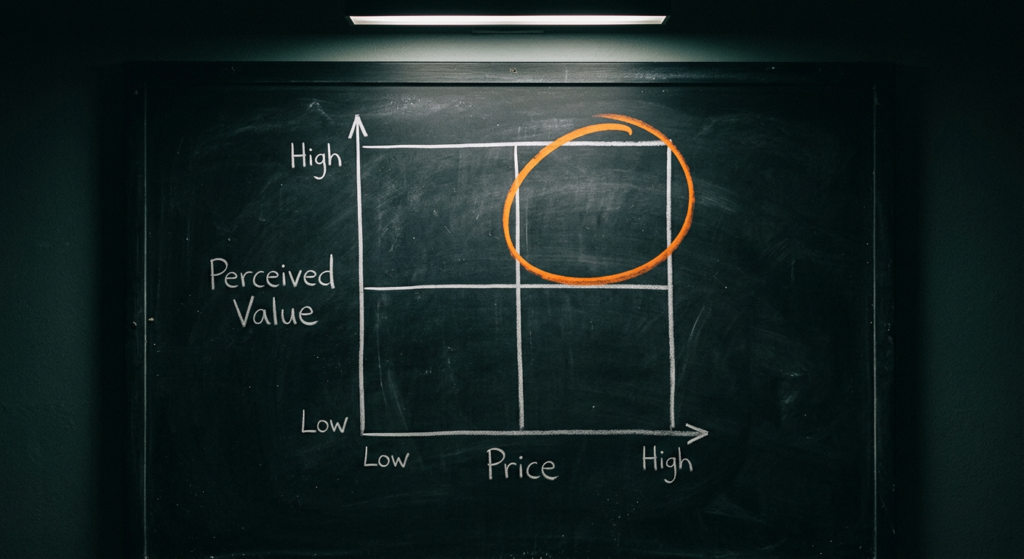
Think about your brand sitting somewhere in a simple two by two grid. On one axis is perceived value — low to high. On the other axis is price — low to high.
Bottom right — high price, low perceived value. This is where objections live. Your price is real but your value has not landed yet. You are asking for more than the customer believes you are worth. Every conversation feels like a negotiation. Every yes feels like a victory that took too long.
Bottom left — low price, low perceived value. You drop the price to close the deal. It works sometimes. But you are building a business on a foundation that requires you to always be the cheapest option. That is not a brand. That is a race to the bottom. And the bottom is a terrible place to build anything.
Top left — high perceived value, low price. Your customers love you. They just are not paying you what you are worth. This is the kind of generous that quietly goes out of business.
Top right — high perceived value, high price. This is where you want to be. Your price is justified because your customer already understands why what you offer is worth it. The conversation is not about the number. It is about when to start.
Every brand lives somewhere in that grid. The question is whether you got there deliberately or accidentally.
What the Price Objection Is Actually Telling You
When a potential customer says your price is too high they are not talking about money.
They are telling you that the value has not landed yet.
That is a communication problem. A positioning problem. A messaging problem.
Not a pricing problem.
You have not shown them clearly enough what they are actually getting. What life looks like on the other side of working with you. What it is costing them to not have it right now.
Lowering the price does not fix any of those things. It just makes the math work temporarily while the underlying problem stays exactly where it was.
And now you have trained your customer to expect a discount. You have signaled that your original price was not real. And you have started the relationship by giving something away rather than earning the right to what you were asking for.
This Is Not Theory
I work with a brand that just tested this exact principle.
Subscription product. Growing audience. Consistent content. Real value being delivered.
But the price was too low. Not because the math did not work. Because the price was signaling the wrong thing to the wrong customer.
The low price attracted people who were willing to try it. Not people who were committed to it. The result was a high volume of signups followed by quick cancellations and failed payments. The revolving door of people who never really believed in it enough to stay.
They doubled the price.
No ads. No new marketing. No changes to the product itself.
Four new subscribers in the first week. Brand new customers. Most of them paid upfront without even taking a free trial.
A completely different customer showed up. One who looked at the value being offered, looked at the price, and thought — this makes sense. I am in.
The product did not change.
The signal changed.
Price is not just what you charge. It is part of how you communicate what you are worth.
How to Move Into the Top Right Quadrant
You do not get to high perceived value by explaining your features more clearly.
You get there by making your customer feel understood before you ever make an offer.
Show them you know their problem better than they can articulate it themselves. Show them what the after state looks like in specific terms they recognize. Show them that every element of what you offer is designed around removing the exact barriers that have been standing between them and the result they want.
When someone feels that understood — when they look at your brand and think this is exactly for me — price becomes a much smaller conversation.
The goal is not to overcome the price objection.
The goal is to build enough perceived value that the price objection never shows up in the first place.
Most brands are selling ingredients. The ones that win are selling certainty.
Certainty commands a premium. Ingredients invite negotiation.
Leean more at www.rickwenner.co