Most businesses skip straight to branding. And that’s their problem.
This 10-step framework is what makes good branding possible. It’s the methodology I use with every brand. Start here — before the strategy, the website, or the campaigns.
“Nobody wants a quarter-inch drill. They want a quarter-inch hole in the wall.”
That’s one of the most useful ideas in marketing — and most businesses miss it completely. They spend their time talking about the drill. The features. The specs. The process. The history of the founder.
Meanwhile, the customer just wants to hang their frame.
The reason this happens isn’t laziness or bad writing. It’s proximity. When you’re too close to your own business, it’s almost impossible to see it the way your customers do. You know too much. You’ve been inside it too long.
And you want everyone to know it — so you say everything, and land nothing.
The homepage that explains too much. The email nobody finishes. The pitch that goes on two minutes too long.
“You can’t write the label when you’re inside the bottle.“
That gap — between what you know about your business and what the market actually understands — is where most marketing breaks down. Fix the gap, and the marketing gets easier. Skip it, and you’ll keep producing content that sounds right to you but doesn’t land.
This framework exists to close the gap. In the right order.
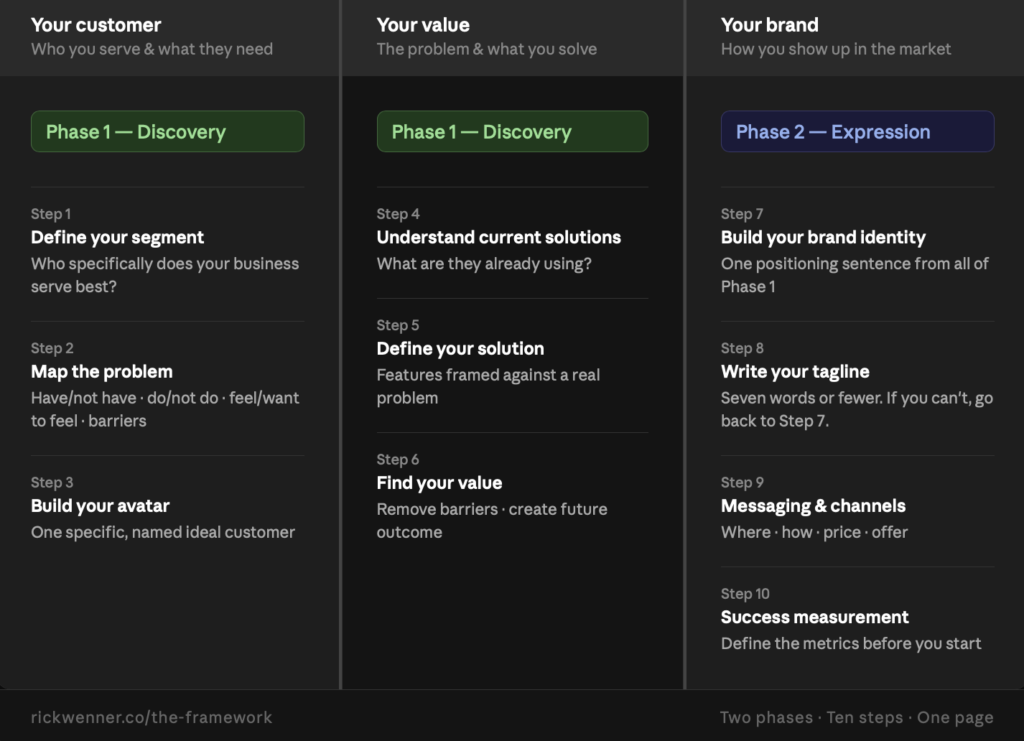
Two Phases. Ten Steps. One Page.
Most businesses start at Step 7. That’s the problem. They jump straight to branding before they’ve done the work that makes any of that possible. Then they wonder why nothing sticks.
Everything in Phase 2 flows from Phase 1. If you skip discovery, your expression is built on assumptions. And assumptions are expensive.
Phase 1 — Discovery Steps 1-6
Phase 2 — Expression Steps 7-10
Steps 1–6. Do this work first.
Step 1
Define your segment
Who specifically does your business serve best? Not everyone. A specific segment.
Step 2
Map the problem
Have/not have · do/not do · feel/want to feel · barriers
Step 3
Build your avatar
Take your segment and make it one person. Specific. Named.
Step 4
Understand current solutions
What is your customer already using to solve this problem?
Step 5
Define your solution
Features framed against the real problem you’ve just mapped.
Step 6
Find your value
What barriers do you remove? What future outcome do you create?
Steps 7–10. Only after you’ve done the work above.
Step 7
Build your brand identity
One positioning sentence from everything in Phase 1.
Step 8
Write your tagline
Seven words or fewer. If you can’t, go back to Step 7. If you confuse, you lose.
Step 9
Messaging and Channels
Where does your customer spend time? How will you reach them?
Step 10
Set your success metrics
Define what winning looks like before you start. Not after.
What it looks like on one page (Front & Back).
This is the whole framework. All ten steps. Everything you need to start. Nothing you don’t.
Because if you can’t say it on one page, you don’t understand it yet. This isn’t a 40-slide deck. It’s not a brand bible. It’s a forcing function — a way to compress everything that matters about your marketing into a single, scannable document your whole team can work from.
Sell them what they know they want. Then deliver what they need.
The framework helps you figure out what they actually want — so you can build the marketing that delivers it.
Sound familiar?
If your positioning feels fuzzy, your messaging feels inconsistent, or you’re producing content without a clear direction — this is where the work starts.